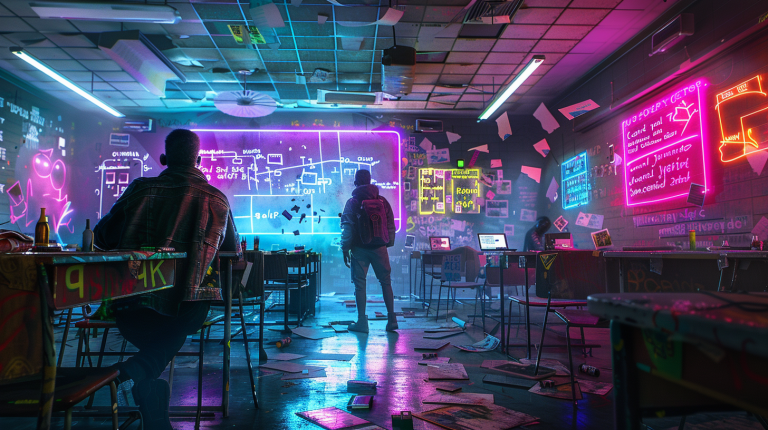
Every so often, I wonder what would happen if EdTech took itself as seriously as the games industry takes Zelda, Animal Crossing, or Grand Theft Auto1.
Imagine an educational game with a cinematic trailer, a global launch, and a fanbase counting down the days. Teachers queueing like gamers on release night. Learners logging in not because they must – but because they can’t wait.
It sounds absurd. But once you imagine it, you can’t unsee how small our ambitions for learning have become. Which is ironic, because the best blockbuster games are very good at teaching.
And the truth is, it’s not about technology. It’s about focus. Whether we choose to treat learning with the same creative intensity we bring to entertainment.
⸻
The Punk EdTech Dream
Punk EdTech would fuse two worlds that rarely share a stage.
From punk, it would steal defiance – the instinct to ship something messy, real, and unapproved. From AAA game development, it would take craft: production discipline, iteration, and respect for the player experience.
The goal? Learning that lives. Tutorials as lessons. Boss fights as assessments. Feedback loops that teach resilience as much as skill.
No “gamification.” No badges. Just full-blooded learning experiences built with the same care as our best games.
⸻
What It Would Take
It wouldn’t come cheap.
A blockbuster-level learning game would need budgets in the tens of millions – not because pedagogy costs much, but because great art, performance, and technology do.
You’d need hundreds of people: designers, engineers, artists, learning scientists, accessibility specialists. Multi-year cycles. Evidence studies. Compliance. Marketing.
And that’s where most investors stop reading.
Somewhere between those extremes – billion-pound blockbusters and ten-person EdTech startups – lies the real opportunity. Mid-sized teams that understand both learning and play. Give them the same respect and resources we give mainstream studios, and the gap begins to close.
⸻
How Punk EdTech Would Feel
Picture it.
You learn chemistry by surviving it – mixing compounds, crafting tools, sometimes blowing yourself up. The game quietly tracks your understanding, reshaping challenges on the fly. Teachers assign missions. Students mod the world.
That’s not a digital worksheet with better graphics. That’s a living system that teaches back.
I’ve seen teenagers spend forty hours designing a self-sustaining ecosystem in Minecraft, organising friends and strangers into a functional guild, then sleep through double science and sociology the next day. That’s not laziness – that’s misdirected brilliance. Punk EdTech is what happens when we build for that energy instead of suppressing it.
⸻
The Cost of Playing Safe
EdTech plays it safe. Procurement loves predictability. Funding rewards polish, not risk. The result? Apps that behave, when what we need are worlds that matter.
Meanwhile, games thrive on danger. GTA shattered moral norms. Resident Evil invented survival horror. Minecraft handed creation to players and built an empire of learning by accident.
If they can take those risks for entertainment, why can’t we for education?
Punk EdTech wouldn’t sanitise knowledge – it would make it dangerous again.
⸻
Breaking the Schoolhouse Walls
Here’s the real question: what if we stopped waiting for permission?
What if education didn’t belong to schools or governments? What if it lived out in the wild – free, messy, participatory?
Most EdTech builds for institutions. But what happens when we build for people instead – for players who learn by doing, exploring, and sharing?
Somewhere between formal schooling and the free-for-all of the internet lies the real frontier – learning spaces built by players, guided by teachers, but owned by no one.
That’s education as rebellion. Learning as a cultural commons.
And let’s be fair – the best teachers already do this every day. They hack systems, rewrite lessons, and turn dry material into living experiences. Punk EdTech is just the digital extension of that same spirit.
⸻
Why We’re Not There Yet
The obstacles are real but predictable:
- Schools buy safety, not spectacle.
- Returns are low, budgets lower.
- Research takes years, publishers want quarters.
- Curricula fragment by region.
- Data privacy slows innovation.
- Developers and educators still speak different languages.
None of these are fatal. They’re just symptoms of a system built for comfort, not curiosity.
⸻
Signs of Life
Still, there are bright spots.
Minecraft: Education Edition keeps proving open-ended play can teach deeply. Kerbal Space Program sneaks orbital mechanics into joyful chaos. Duolingo makes practice addictive.
Indie teams and NGOs are shipping brilliant, research-backed learning games. They’re doing it without blockbuster budgets – or the cultural permission that comes with them.
That’s where the next wave will come from.
⸻
What Could Change
To unleash Punk EdTech, we’d need:
- Long-term funding that values impact over ROI.
- Studios and schools co-creating, not contracting.
- Open ecosystems that invite teachers and learners to extend content.
- Procurement reform that rewards outcomes, not compliance.
- Teachers as designers, not gatekeepers.
Change doesn’t need more tech. It needs nerve.
⸻
The Punk Mindset
The punk revolution won’t start with AAA money. It’ll start with people.
Teachers, indies, and students hacking learning together in garages, classrooms, and Discord servers. Building. Sharing. Remixing. Breaking things and learning from the wreckage.
This isn’t a product pitch. It’s a wake-up call.
That’s punk. That’s how new worlds get made.
⸻
Final Thought
Punk EdTech isn’t about tools – it’s about focus.
We already know how to build systems that teach empathy, creativity, and resilience. We just aim them at entertainment.
The future of learning won’t come from another LMS update. It’ll start the day we stop asking, “Can this fit inside a school?” and start asking, “What if learning didn’t need schools at all?”
EdTech doesn’t need permission.
It needs focus.
- Yes, GTA. A 27 year old game. I remember the impact. ↩︎

Ben, this is great stuff. While I am not a formal educator, I do recognize that our current education systems are increasingly not fit for purpose. I wonder if the real opportunity here is around encouraging subversive grass roots emergence rather than waiting for “long term funding that values impact” to emerge? Your dad does make a good point when he (quite often) speaks about the power of loosely connected small groups chipping away from within. It is out of acting on thinking like yours here that worthwhile change occasionally springs!
Thanks for the food for thought.
Thank you Ciaran! I think you absolutely have a point – maybe it doesn’t need reinvention, mainstream games teach people all the time, it just needs people to lean in the opportunities.